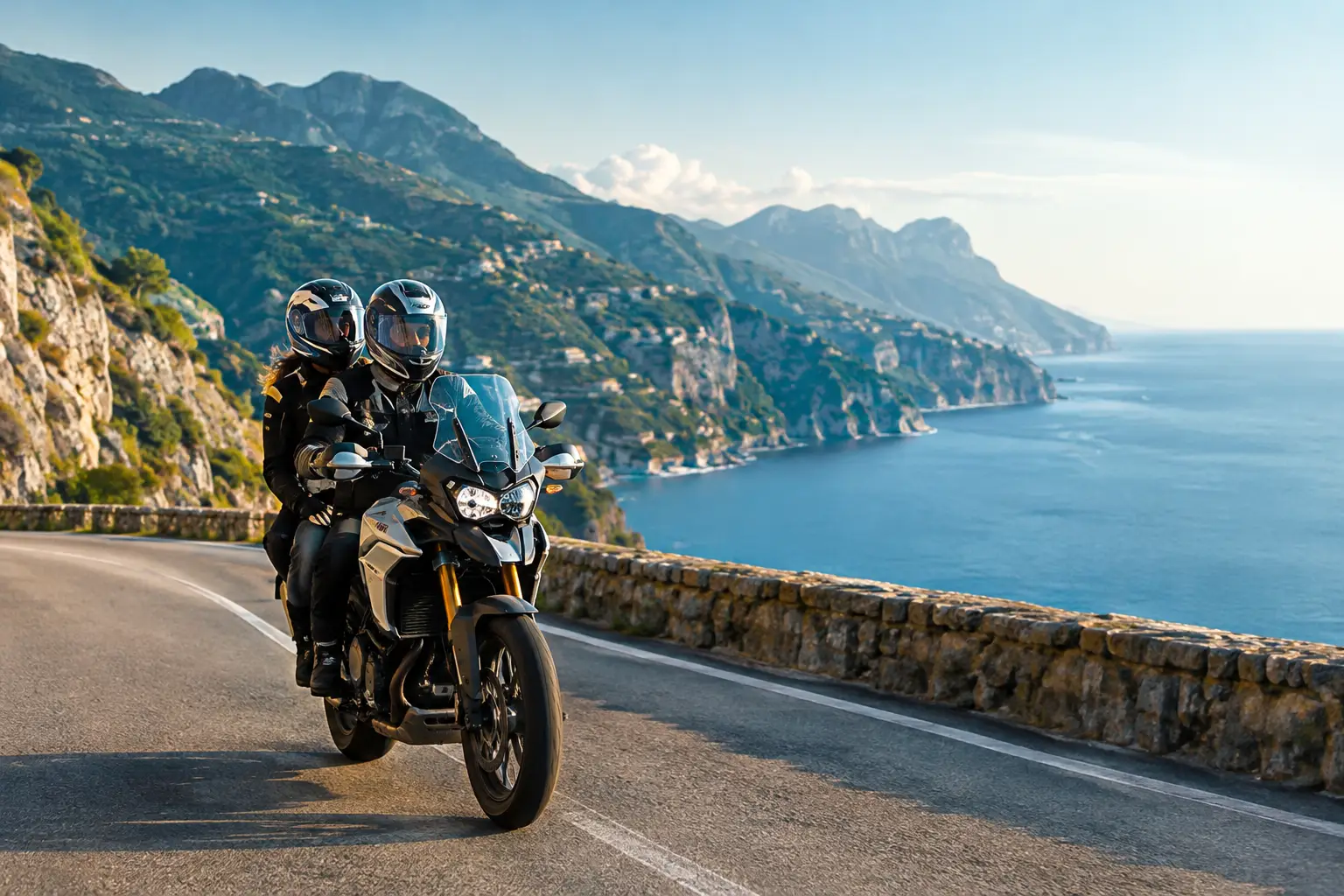

The Italian motorcycle tourism trends 2026 riders will feel most strongly are not about riding farther or checking more famous places off a list. They are about riding better. For travelers flying in from the United States and beyond, Italy is becoming less of a fast-moving grand tour and more of a carefully paced experience: superb motorcycles, minor roads with real character, long lunches, family-run hotels, and enough time to enjoy each region rather than simply pass through it.
That is good news for riders who have already spent enough vacation days in traffic, on generic highways, or following a crowded procession to the same postcard viewpoint. The magic of Italy on two wheels has always lived beyond the big roads. In 2026, more riders are choosing trips that make room for it.
The classic question used to be, “How much of Italy can we cover in ten days?” A better question now is, “Which part of Italy do we want to know?” That shift is shaping the most rewarding motorcycle holidays.
A focused regional route lets the riding breathe. In Tuscany, that may mean a morning of flowing roads through Chianti and the Val d’Orcia, followed by a hill town that most bus tours miss. In the Dolomites, it can mean choosing a handful of magnificent passes and having time to stop when the light changes on the peaks. In Sicily, it may mean linking volcanic landscapes, old fishing villages, and inland roads where the pace belongs to local life.
Long transfer days still have their place, particularly on a multi-region or multi-country journey. But riders are increasingly aware of the trade-off. A route packed with hotel changes can look impressive on paper while leaving little time to enjoy the places between the curves. The strongest 2026 itineraries use sensible daily distances, include rest days or two-night stays where they add value, and give each riding day a distinct personality.
Small groups are becoming more appealing precisely because the roads and experiences riders want are not built for a convoy of 20 motorcycles. A handful of friends, or a small group of like-minded riders, can pull into a village square, park outside a local trattoria, and settle in without changing the atmosphere of the place.
There is also a practical advantage. Italy rewards flexibility. A local guide can turn down a quiet lane after spotting traffic on the main route, suggest a better lunch stop, or make a short detour to a viewpoint that does not appear in the usual guidebooks. That is harder to do when a large group needs a rigid schedule.
For many fly-in riders, guided travel remains the reassuring choice for a first Italian motorcycle trip. You have a local rider leading the way, hotels arranged, luggage cases on the motorcycle, and support when the unexpected happens. Yet the appeal is not being managed from morning to night. It is being free to enjoy the ride because the difficult decisions have already been made well.
At the same time, self-guided motorcycle touring is becoming more sophisticated. Independent riders do not necessarily want to spend months researching every overnight stop, road restriction, mountain pass, and parking situation. They want the satisfaction of riding at their own pace with a route that has been tested by people who know the country.
The best self-guided experience sits between total independence and total improvisation. It provides thoughtfully chosen accommodation, daily routes that favor scenic secondary roads, clear navigation, and useful local advice. Then it leaves room for a second espresso in a piazza, an unplanned stop at a winery, or an afternoon spent wandering a historic town instead of chasing one more set of switchbacks.
Customized routes are growing for the same reason. Couples, groups of friends, and returning visitors often have clear preferences: more mountains, less city traffic; great food, but no late nights; a Ducati road bike for one rider and an adventure bike for another; perhaps a route that starts in Florence and finishes on the Ligurian coast. A tailored tour makes sense when the details genuinely matter. For a rider with limited vacation time, they usually do.
The Dolomites, Amalfi Coast, Tuscany, and Sicily will always deserve their reputation. They offer some of the finest motorcycling scenery anywhere. But a key part of Italian motorcycle tourism in 2026 is the growing desire to ride the regions around the headline destinations, not just through the best-known roads.
Think of Abruzzo’s high plateaus and ancient stone villages, the curves of Le Marche between the Apennines and the Adriatic, Piedmont’s vineyard roads beneath the Alps, or Basilicata’s dramatic, sparsely traveled landscapes. These places can deliver the feeling riders come to Italy for: a road that seems designed for a motorcycle, a village lunch with no hurry, and a landscape that changes completely over a few miles.
This does not mean every lesser-known region is automatically better. Some are more remote, have fewer hotel choices, and demand a little more patience with road surfaces or weather. That is part of why route knowledge matters. A good itinerary balances a sense of discovery with the confidence that your motorcycle, lodging, fuel stops, and daily mileage all work in the real world.
Motorcycle travelers are giving more weight to where the day ends. The overnight stop is no longer simply a secure parking space near the route. Riders want a place with warmth, regional cooking, a good local wine, and hosts who can make a one-night stay feel personal.
Italy makes this easy to understand. A day in Emilia-Romagna can finish with handmade pasta and Parmigiano-Reggiano. In Puglia, the reward might be seafood by the sea and a walk through whitewashed lanes. In the north, mountain cuisine brings a different rhythm after a day of alpine passes. These are not extras added after the riding. They are part of the memory of the road.
The trend favors family-run hotels and trattorias over anonymous, standardized properties. Large hotels can be the practical answer in a major city or during a busy event period, so there is no single rule. But where a smaller local property is available and reliable, it often gives a motorcycle trip more soul.
Riders arriving from overseas are also placing greater value on the quality and suitability of the motorcycle. The right machine depends on the route and the rider. A sporty naked bike can be perfect for paved Tuscan curves. A touring motorcycle brings excellent comfort for two-up travel and longer distances. An adventure bike is a fine choice for broken pavement, mountain routes, and riders who like a more upright position, even when the itinerary stays on asphalt.
What matters most is not chasing the biggest engine or the newest badge. It is arriving to a well-prepared motorcycle with good tires, proper luggage, sensible ergonomics, and the confidence to ride all day. Unlimited mileage and secure luggage cases may sound like simple details, but they change the experience for travelers who are carrying everything they need across an unfamiliar country.
Seasonality is becoming a more deliberate choice, too. May, June, September, and early October remain superb months for much of Italy, with pleasant temperatures and excellent riding conditions. July and August can be wonderful in the high mountains, but they bring serious heat in central and southern regions, along with heavier holiday traffic in popular coastal areas. Spring and fall often offer the better balance, although mountain weather can always have its own opinion.
The strongest travel trend may be a simple one: riders want to feel welcome, not merely entertained. That means respecting historic centers, riding quietly through villages, choosing local businesses, and accepting that a good Italian road is not a racetrack. Technical riding is part of the pleasure, but so is arriving relaxed enough to enjoy the evening.
It also means leaving space for the unplanned moment. A local festival in a village square, a farmer selling fruit at a roadside stand, a sudden view across a valley, or a recommendation from a hotel owner can become the story you remember most. Those moments cannot be scheduled, but a well-designed trip gives them room to happen.
For riders considering Italy in 2026, the best choice is unlikely to be the itinerary with the most miles or the most famous names. Choose the one that fits the way you ride, the places you are curious about, and the pace that lets Italy reveal itself one unforgettable corner at a time.


Subscribe to our newsletter below and never miss the latest tour or an exclusive offer.