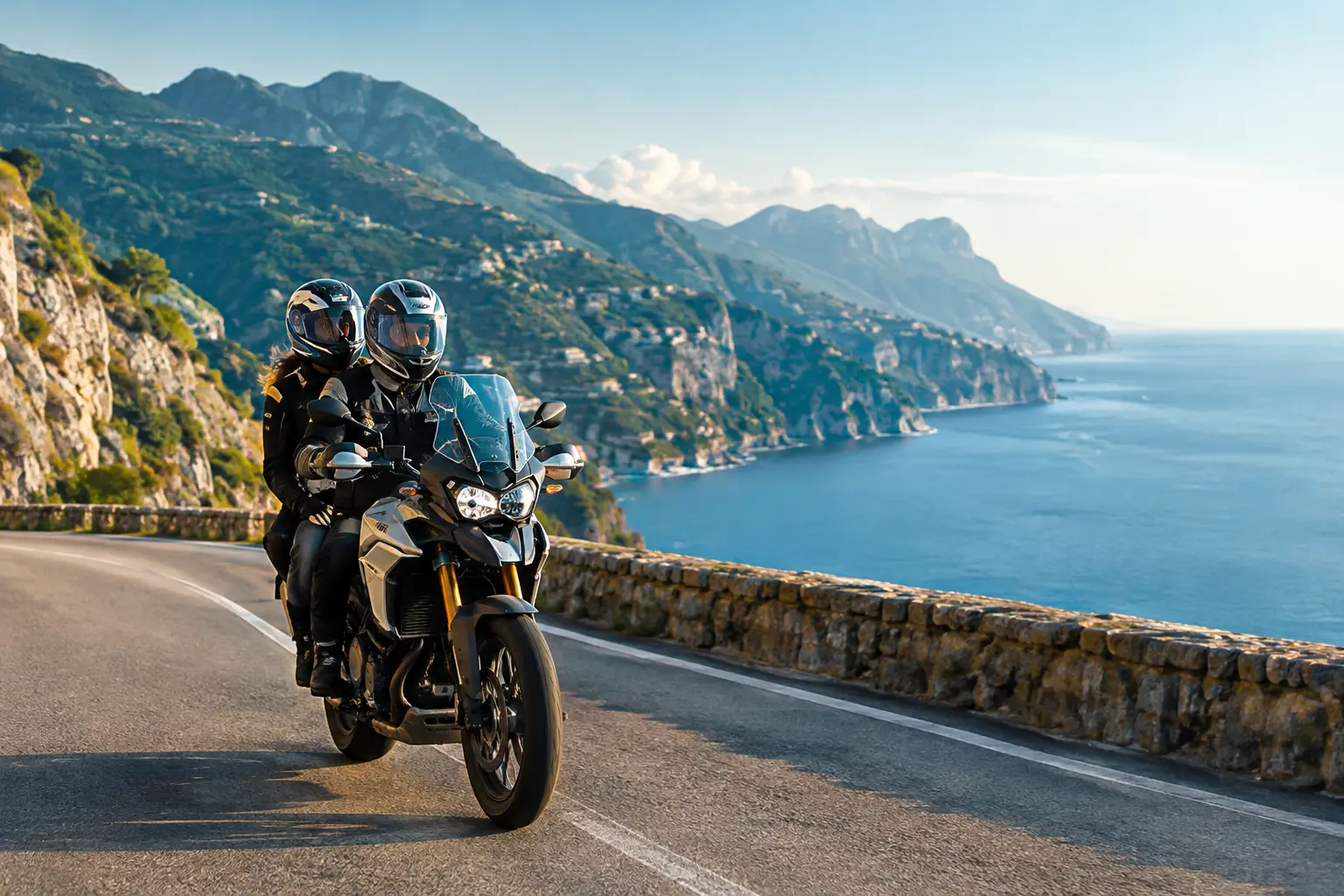

The best day on an Italian motorcycle rarely begins on the famous road. It begins when you leave the busy valley behind, turn onto a narrow provincial lane, and find yourself climbing through olive groves, vineyards, or chestnut woods with a village trattoria waiting at the other end. This Italian motorcycle route planning guide is built around that idea: ride less highway, see more of the real country, and leave enough time to enjoy it.
Italy looks compact on a map, but it does not ride compact. A 150-mile day through Tuscany can feel relaxed. The same distance across the Dolomites, along the Amalfi Coast, or over the Apennines can become a demanding full day of hairpins, photo stops, traffic, and slow village passages. Good planning is not about collecting the greatest number of miles. It is about creating a route that feels generous from breakfast until the evening aperitivo.
Before tracing a single line on a map, decide what you want to remember most. Italy offers dramatically different motorcycle experiences, and trying to combine all of them in one short trip usually means too much packing and too many transit days.
For rolling curves, cypress-lined ridges, wine country, and medieval towns, central Italy is hard to beat. Tuscany and Umbria reward riders who enjoy flowing secondary roads and long lunches. Emilia-Romagna adds excellent pavement, serious food, and the Motor Valley heritage around Bologna and Modena. The Marche, Abruzzo, and the Apennines offer wilder, quieter riding for those who prefer mountain scenery without the crowds of the best-known northern passes.
The Alps and Dolomites bring a different rhythm. Here, the road is the event: tightly stacked bends, high passes, sudden views of pale rock faces, and weather that can change in one climb. Plan fewer miles and accept that popular passes may be busy in high summer. A June or September ride often gives you a better balance of open roads, comfortable temperatures, and calmer hotels.
Southern Italy and Sicily are for riders who want warmth, intensity, and contrast. The scenery shifts quickly from coastal cliffs to ancient hill towns and dry inland landscapes. Road surfaces can be more variable, and navigation needs more patience, but the reward is a strong sense of place and wonderfully direct local hospitality.
A good first decision is to choose one major region, or two neighboring regions, rather than chasing every famous name in the country.
American riders are often used to long highway days. In Italy, highway mileage is useful when you need to reposition, but it is seldom the reason you came. Once you are on the smaller roads, daily distance must be judged by terrain, not the odometer.
On rolling country roads, 120 to 170 miles can make a satisfying day when you include fuel, coffee, photographs, a town walk, and lunch. In high mountains or on very technical coastal roads, 90 to 130 miles may be more than enough. If your route contains several famous passes, a ferry crossing, or a city arrival, reduce the mileage again.
Try to be off the motorcycle by late afternoon. This is not because Italian evenings are quiet. Quite the opposite. Arriving with time to shower, stroll through a historic center, and sit down for dinner is part of the magic of Italy on two wheels. A route that delivers you to a family-run hotel at 6:30 p.m. after a rushed day of navigation is less rewarding than one that gets you there at 4:30 with a little energy left.
For a week-long trip, include at least one two-night stop. It gives you a rest from luggage, a chance to ride unburdened, and flexibility if rain rolls across the mountains. A loop from the same hotel can be one of the finest days of the whole trip.
Do not rely on a navigation app’s arrival time as your riding plan. It cannot know that a village market has narrowed the road, that you will stop for an espresso, or that the last 20 miles climb through a series of second-gear bends. Add time generously, especially on roads marked as scenic, coastal, mountainous, or historic.
The same principle applies to fuel. Italy has ample gas stations, but rural stations may close overnight or have automated pumps that do not accept every foreign card. Fill up before entering a remote mountain section, and do not wait until the reserve light becomes a travel companion.
The most memorable routes usually connect small towns by provincial and regional roads. These are the roads that reveal the country: a bakery opening in a stone village, a vineyard road folding around a hillside, a church bell marking the hour as you ride into a piazza.
That does not mean every tiny line on the map is a winner. Some minor roads are narrow, broken, steep, or simply slow enough to turn a beautiful plan into an exhausting one. Balance your route with well-maintained secondary roads, then use smaller lanes selectively for a special viewpoint, a hotel approach, or a village you genuinely want to visit.
Avoid routing through the center of major cities whenever possible. Historic city centers may have restricted traffic zones known as ZTLs. Cameras record vehicles entering without authorization, and fines can arrive long after your vacation ends. Choose accommodation with secure parking outside the restricted area, or confirm that the hotel can register your license plate if access is necessary.
Toll highways have a place. They are useful for escaping an airport area, bypassing a large city, or gaining a day when weather disrupts your plan. Use them as a tool, not a default setting. One purposeful highway stretch can preserve a magnificent afternoon in the hills.
Italian roads ask for alert, respectful riding. Pavement is often excellent, particularly on major mountain and regional routes, yet surfaces can change quickly after winter or heavy rain. Watch for patched asphalt, polished stone in old town centers, gravel near driveways, and agricultural mud on rural lanes.
In the mountains, shade can hold moisture long after the sun has dried the exposed corners. In coastal areas, tourist traffic and scooters demand patience. In cities, traffic moves with confidence and close spacing. Ride defensively, keep your lane position deliberate, and resist the temptation to match every local rider’s pace.
Season matters as much as region. Northern passes may be closed or icy well into spring, while July and August can bring fierce heat to the south and dense traffic to famous coastal roads. Spring offers green landscapes and lively weather. Early fall often provides warm days, harvest season, and roads that feel more settled after summer crowds have gone home.
Bring layers even in summer. A lightweight waterproof layer, warm mid-layer, ventilated gloves, and ear protection are more useful than bulky luggage. Temperatures can move from hot lowlands to chilly summits in a single morning.
The right overnight stop transforms a riding day. Rather than booking only large cities, look for smaller historic towns, countryside inns, and hotels near a walkable center. You want a place where the motorcycle is safely parked and dinner is an easy stroll away, not another ride on unfamiliar roads after dark.
Plan lunch as a destination, not an interruption. Italy is full of roadside bars, but a long ride becomes much more memorable when you arrive at a village known for local pasta, cheese, seafood, or wine. Leave room in the schedule for it. A proper lunch might take longer than expected, and that is usually a sign that you chose well.
Be careful with the common mistake of booking a beautiful hotel that sits 25 miles beyond your intended destination. In the mountains, those 25 miles may take an hour. Read the approach road, check parking, and understand whether the property is truly convenient for the next day’s direction.
There is no single right way to ride Italy. A guided small-group tour suits riders who want local knowledge in front of them, a smooth daily rhythm, and the pleasure of sharing the experience with a few like-minded travelers. A good guide knows which pass is temporarily closed, where the best lunch is hidden, and when a beautiful road is better ridden in the opposite direction.
A self-guided trip is ideal if you value independence but do not want to spend months researching hotels, routes, parking, and daily logistics. You still choose your pace, yet begin with tested roads and practical support. A tailored route makes sense for couples, friends, or returning riders with a particular dream: perhaps a week of Ducati country, the quiet roads of Abruzzo, or a coast-to-mountains route across Sicily.
At CIMT, Francesco’s route planning comes from years spent riding these roads, not simply from software. That local experience matters when the map offers ten possible turns and only one leads to the kind of day you came to Italy for.
The finest Italian motorcycle routes have structure, but they should never feel like a timetable. Keep one or two optional detours in your navigation, know where you need to sleep that night, and then allow the day to breathe. You may stop because a hill town appears on a ridge, because a local recommends a road, or because the view over a valley is too good to pass without taking off your helmet.
Plan carefully enough that you feel relaxed, then ride with enough freedom to notice where Italy is inviting you next.


Subscribe to our newsletter below and never miss the latest tour or an exclusive offer.