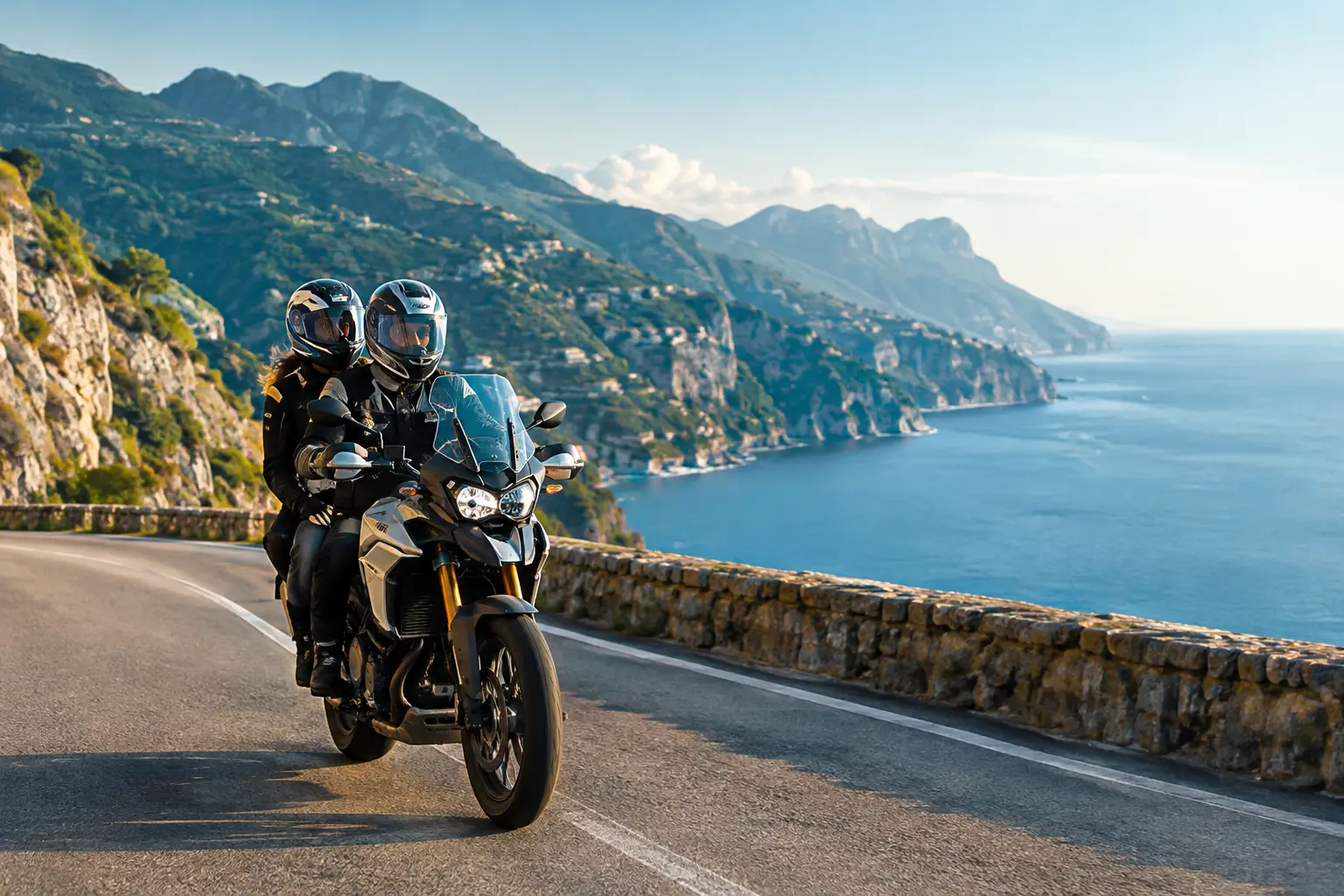

The first hairpin above a Dolomite valley can make even a very experienced rider smile inside a helmet. Then a local Fiat appears around the next blind bend, a cyclist is climbing steadily ahead, and the road narrows beneath a stone wall. Learning how to navigate Italian mountain roads is not about riding timidly. It is about reading the terrain, respecting the rhythm of local traffic, and leaving enough attention to enjoy the magic of Italy on two wheels.
Italy’s mountain roads are among the finest riding roads anywhere. They can also change character quickly: a broad, freshly paved pass road can become a damp, single-lane lane through a chestnut forest within a few miles. Ride them with patience and good preparation, and they deliver the kind of day you remember long after the final espresso.
The best approach is to treat every mountain road as a sequence of changing conditions, not as a racetrack. The scenery is spectacular, but the road deserves your full attention. Sight lines are often short, corners can tighten unexpectedly, and surface grip varies with altitude, shade, weather, and local farm traffic.
Set a pace that lets you stop within the distance you can see. This matters particularly on blind right-hand corners, where an oncoming car may be using more of the road than you expect, or where a delivery van may be stopped just beyond the apex. Enter calmly, look through the turn, and keep your line tidy rather than chasing an ideal racing line.
On tight switchbacks, use the full width of your own lane only when it is clearly available. Many Italian mountain roads have no center line, and even those that do may be narrow enough that a bus, camper, or agricultural vehicle needs room. The pleasure is in linking the curves smoothly, not in arriving at the summit ten minutes earlier.
A navigation app is useful for direction, but it cannot tell you everything that matters to a motorcycle. In the Alps, Dolomites, Apennines, and the hill country of central and southern Italy, a minor road may be wonderfully empty yet patched, rippled, gravelly at its edges, or wet beneath trees.
Watch for pale gravel washed onto turns after rain, especially near driveways and drainage channels. In wooded sections, damp leaves, moss, and a strip of moisture can remain long after the open road has dried. Near villages, polished stone, painted markings, manhole covers, and cobbles can become slippery when wet.
Italian road crews also use loose chippings during repairs. A temporary sign may warn of gravel, but sometimes the first clue is the changed texture and sound beneath your tires. Ease off early, avoid abrupt braking or throttle inputs, and let the bike move naturally rather than fighting it.
Italian mountain roads are shared roads. You may meet committed cyclists riding legendary climbs, hikers crossing between trailheads, shepherds moving animals, and local drivers who know every bend by heart. Their familiarity should not tempt you to match their pace.
Give cyclists generous room when passing and be prepared for them to move around potholes or rough pavement. On narrow roads, wait for a clear straight or a safe pull-off rather than forcing a pass. A friendly wave costs nothing and fits the spirit of riding here far better than an impatient horn.
Buses and trucks deserve special caution. On some passes, a coach can appear in a curve with very little warning and may need extra road space. If you see one approaching, slow down and be ready to tuck in near the right edge where it is safe. Do not hug the shoulder blindly, though. Italian mountain roads sometimes hide broken pavement, drainage grates, and loose stones at the margins.
In small villages, expect traffic to slow suddenly. A family-run trattoria, a church square, or a weekend market can bring cars and pedestrians onto a road that looked deserted a minute earlier. This is part of the experience. Slow down, take it in, and save the spirited riding for the sections where the road and visibility genuinely invite it.
Italy’s road signs are generally clear, but mountain riding rewards a quick understanding of a few common warnings. Curves, steep descents, falling rocks, snow chains, and road narrowing are all signposted. Take them seriously, especially if weather has been unsettled.
Posted speed limits apply, but conditions often call for considerably less than the number on the sign. Town entries, hairpin sequences, narrow bridges, and descending roads demand restraint. Fixed and mobile speed enforcement exists, including Autovelox cameras, and it is never worth allowing a fine to interrupt a sublime trip.
For navigation, download your route and maps before leaving your hotel. Mountain valleys can have weak cell service, and a phone that loses signal just before a complex junction is not much help. Keep the device for guidance, but do not stare at it through a series of bends. Pull over somewhere safe if you need to confirm a turn.
Paper notes can be surprisingly useful on a multi-day ride. Write down the next major town, pass name, or fuel stop before setting off. Italian road signs commonly direct you by towns rather than by route numbers alone, and knowing the next place name makes junctions much easier to read.
A warm morning beside Lake Garda or in Tuscany can become a cold, wet afternoon at 7,000 feet. Even in summer, high passes may bring sudden rain, fog, wind, or sharp temperature drops. Early spring and late fall add the possibility of snow, icy shaded sections, and seasonal road closures.
Check the forecast for the pass itself, not just for your overnight town. Pack a waterproof outer layer and warm gloves where they are easy to reach, rather than buried at the bottom of a luggage case. A thin insulating layer can turn a chilly, tiring descent into a comfortable one.
If fog removes your view of the road ahead, reduce speed dramatically and increase your following distance. The temptation to press on is understandable when a beautiful hotel dinner is waiting down the valley, but visibility is non-negotiable. Stop for a coffee, check conditions, and let the weather move through if necessary. In Italy, there is rarely a bad excuse for a pause at a bar.
Long descents can heat brakes quickly, particularly with a passenger, luggage, or a fully loaded touring motorcycle. Select an appropriate gear before the downhill steepens and use engine braking to control speed. Brake firmly and progressively when needed, then release, rather than dragging the brakes for miles.
Leave additional space behind cars on downhill sections. Local drivers may brake unexpectedly for a viewpoint, a wandering goat, or a favorite parking spot. If you smell hot brakes, feel a fading lever, or sense that your riding is becoming tense, pull over safely and take a few minutes. The mountains will still be there.
Mountain regions do not offer the same density of fuel stations as major cities and highways. Fill up when the tank reaches roughly half on a remote route, especially on Sundays, holidays, or outside the main summer season. Some self-service stations require a card and may operate with limited assistance, so do not rely on finding a staffed station late in the day.
Start earlier than you think you need to. Morning roads are cooler, quieter, and often clearer before tour buses, cyclists, and afternoon weather arrive. It also gives you time to stop in the villages that make a route special: a tiny bakery in the Apennines, a mountain cheese shop, or a trattoria where lunch is a proper part of the day rather than a fuel stop.
Avoid overloading the itinerary. A route that looks short on a map may include dozens of switchbacks, photo stops, village crossings, and a slow climb behind a tractor. In the mountains, fewer miles often mean a richer day. The right plan leaves room for the unexpected viewpoint and the invitation to linger over local food.
Not every spectacular road is right for every rider or every bike. A wide, flowing alpine pass may suit a couple on a large touring motorcycle, while a steep, tight lane through the Ligurian hills may be more enjoyable on a lighter machine. Gravel, poor pavement, steep cambers, and hairpins with little runout demand a different level of comfort than a well-engineered main pass.
This is where tested local route planning makes a real difference. At CIMT, we build rides around roads that are beautiful and rewarding, while considering the bike, season, group experience, fuel range, hotel location, and realistic pace. The goal is never simply to collect famous pass names. It is to have a great day in the saddle and arrive ready to enjoy the evening.
Carry your license, rental documents, insurance information, and the required safety gear, but bring an equally useful mindset: stay curious, stay unhurried, and leave room for the road to surprise you. On an Italian mountain road, the finest moments are often not at the summit. They are the quiet miles between villages, when the next curve opens onto a valley you never expected to see.


Subscribe to our newsletter below and never miss the latest tour or an exclusive offer.