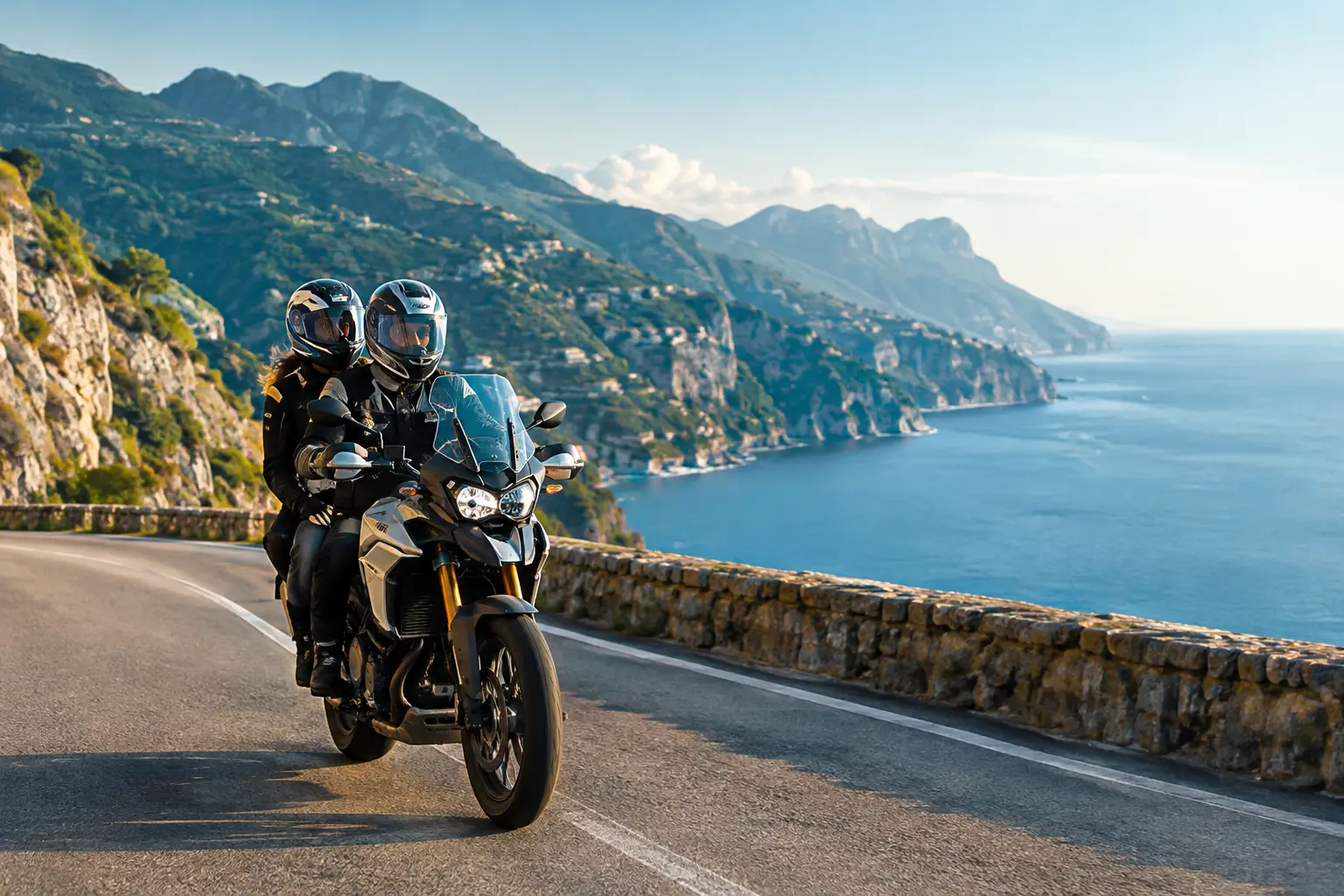

The assumption that a premium journey is defined solely by the destination is a fundamental misconception in the luxury travel sector. For the sophisticated moto tourist, the 2026 season requires a rigorous approach to road travel that prioritizes regulatory compliance and technical excellence over mere aesthetics. You likely recognize that the true value of a tour lies in the seamless integration of high-performance machinery with a deep respect for local legal frameworks. It’s a sentiment shared by the 84% of premium travelers who now prioritize guided expertise to avoid the complexities of Italian ZTL zones, which saw a 12% increase in enforcement actions during the last fiscal year.
This guide provides a professional framework to help you navigate these intricacies with the confidence of a seasoned expert. We promise to equip you with the specific knowledge needed to select accredited tour operators and high-quality equipment, ensuring your safety remains paramount according to the standards of Legislative Decree No. 285. We’ll examine the essential intersection of cultural immersion and road safety regulations, providing a clear methodology for your next Italian expedition.
The definition of a moto tourist transcends the simple act of operating a vehicle; it establishes a formal framework for road-based cultural exploration. This discipline isn’t merely about transit. It’s a structured methodology where the journey’s technical execution is as significant as the destination’s historical value. Historically, motorcycle touring was associated with rugged, survivalist adventure. However, the industry has undergone a paradigm shift toward refined luxury and institutionalized travel standards.
By 2026, experts project a 15% increase in the “slow-ride” movement across Europe. This trend prioritizes deliberate, sensory-rich navigation over high-speed transit. It’s a response to the saturation of digital travel, favoring authentic, tactile experiences that only two wheels can provide. Professionalism in this sector is now measured by a rider’s ability to harmonize mechanical precision with cultural appreciation.
A sophisticated rider operates within a strict set of core values: safety, respect for local heritage, and technical proficiency. This category specifically focuses on road-only experiences, utilizing high-displacement machinery, typically exceeding 1,000cc, to ensure long-distance comfort and stability. It’s a standard that excludes off-road vehicles and low-displacement scooters under 250cc. These exclusions aren’t arbitrary; they maintain the integrity of the professional touring category, which demands equipment capable of sustained, high-level performance on paved international networks.
Two wheels facilitate a deeper connection with the landscape that’s impossible to achieve within the confines of a car. The moto tourist serves as an ambassador of international road culture, bridging the gap between local communities and the global traveling public. This role requires a delicate balance. The rider must manage technical goals, such as mastering the 48 hairpins of the Stelvio Pass, while remaining fully immersed in the region’s gastronomic and historical context.
The professionalization of this travel style ensures that every itinerary is more than a trip. It’s a curated educational experience. When a rider chooses the slow-ride approach, they’re investing in a legacy of travel that values quality over quantity. It’s about the precision of the line taken through a corner and the authenticity of the ingredients in a roadside trattoria.
Operational excellence in motorcycle touring is defined by a rigorous logistical framework that transcends simple navigation. A professional expedition requires a structured methodology to ensure both safety and cultural immersion. The primary foundation of this experience is a curated itinerary designed by road experts who prioritize technical engagement over mere transit. While casual riders may rely on digital mapping, a seasoned moto tourist seeks a path where every curve is calculated for its rhythmic quality and safety profile.
The logistical backbone of a premium tour is the support vehicle. This unit functions as a mobile command center, managed by a dedicated technician who handles luggage transport and immediate mechanical assistance. This arrangement allows participants to focus entirely on the riding experience without the burden of heavy panniers. Additionally, accommodation selection follows strict criteria, focusing on 4-star and 5-star establishments that provide secure parking and specific amenities for riders. Before departure, it’s essential to review the U.S. State Department travel advisory for Italy to align your expectations with current safety and regulatory standards.
Group dynamics are overseen by a professional tour leader, a figure who acts as a mediator between the group and the local environment. This leader manages the pace and ensures that the collective experience remains harmonious. For those seeking this level of institutional rigor in their travels, exploring certified motorcycle expeditions ensures a balance between technical riding and organizational reliability.
The methodology for route selection prioritizes secondary provincial roads, which offer superior asphalt quality and reduced heavy vehicle traffic compared to national highways. Planning for rhythm involves a precise calculation of mileage, typically limited to 250 kilometers daily, to allow for frequent rest stops and mechanical checks. A perfect day for a moto tourist consists of approximately six hours of active saddle time interspersed with two hours of structured cultural exploration.
Professional fleets must consist of late-model, high-performance motorcycles, typically from the 2023 or 2024 production years. Maintenance protocols follow a strict 10-point safety check before every departure, ensuring that braking systems and tire integrity meet factory specifications. Premium tours prioritize road-specific motorcycles because their ergonomic geometry reduces rider fatigue, allowing for maximum comfort during multi-day transits across varying elevations.
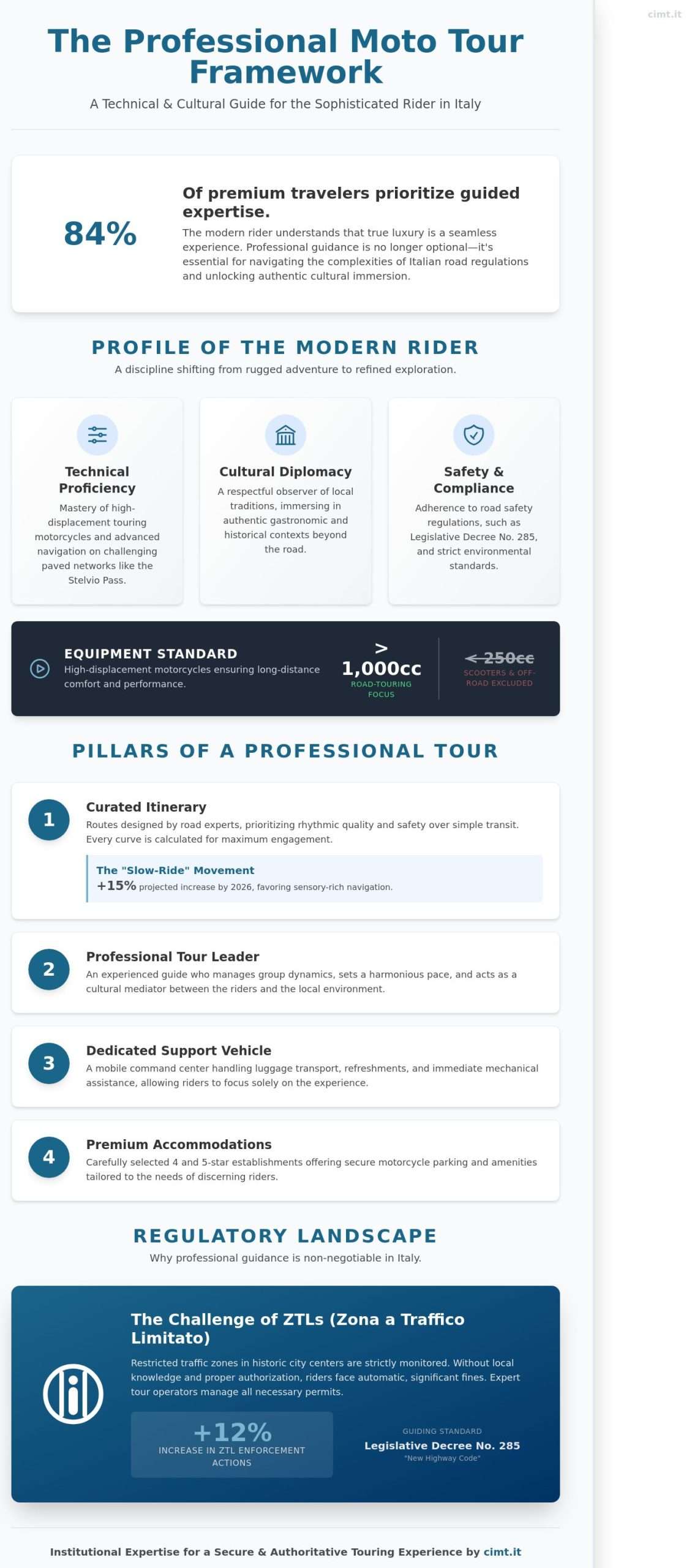
Operating a motorcycle within the Italian peninsula requires strict adherence to a rigorous regulatory framework established by the Codice della Strada, specifically Legislative Decree n. 285/1992. For the international moto tourist, legal compliance begins with the possession of a valid International Driving Permit (IDP) alongside a national license. This isn’t merely a recommendation; it’s a statutory requirement for non-EU residents under Article 135 of the Highway Code. Failure to produce this document during a routine institutional check can result in immediate administrative sanctions exceeding €400 and the potential impoundment of the vehicle.
Institutional safety standards in Italy prioritize technical gear and disciplined road etiquette. While European Directive 2006/126/EC harmonizes licensing across the continent, local enforcement focuses heavily on helmet certification. Only helmets meeting ECE 22.05 or the newer 22.06 standards are legally permitted. Professional tour operators serve as essential intermediaries in this context, ensuring that every participant meets these legal benchmarks before departure. This oversight provides a layer of institutional security that independent riders often lack.
Specific signage dictates the flow of traffic with legal precision. Every moto tourist must recognize the red circle of the Divieto di Transito (No Entry) and the blue Obbligo (Mandatory) signs. Speed enforcement often utilizes the Sistema Tutor; this automated network calculates average speeds over long distances rather than at a single point. On motorways (Autostrade), the limit remains 130 km/h, while secondary extra-urban roads typically restrict movement to 90 km/h. Local police forces, including the Polizia Stradale, maintain a constant presence to ensure these limits are respected.
The Zona a Traffico Limitato (ZTL) represents the most significant administrative hurdle for riders in historic centers. These restricted areas utilize automated camera enforcement to protect the environmental and structural integrity of ancient cities. Unauthorized entry triggers fines ranging from €83 to €332 per infraction. These regulations align with the broader objectives of UNESCO’s Sustainable Tourism Programme, which emphasizes the preservation of cultural integrity through controlled access. Professional tour management mitigates this risk by coordinating with municipal authorities to secure temporary transit permits. This institutional oversight removes the burden of retroactive fine management, ensuring the rider remains focused on the cultural experience.
The construction of a professional touring itinerary requires a methodology that transcends simple navigation. For the discerning moto tourist, the journey functions as a structured narrative arc where each day builds upon the previous one. This progression often begins with the accessible coastal flavors of the Tyrrhenian or Adriatic seas and culminates in the complex, earthy profiles of the Apennine or Alpine regions. By aligning the route with the Slow Food movement, established in 1986 in Bra, riders engage with a philosophy that prioritizes biodiversity and local heritage. This connection isn’t merely aesthetic; it’s a commitment to supporting the 1,500+ Italian “Presidia” products that protect unique food traditions from extinction.
Integrating high-end gastronomy into a rigorous riding schedule demands precise logistical planning. It’s not about finding a place to eat; it’s about selecting a venue that serves as a geographical case study. Italy’s 20 regions offer distinct culinary identities that change every 50 kilometers, dictated by soil composition and microclimates. The mid-day meal represents the most vital cultural stop for a rider because it provides a sensory anchor to the morning’s geography, allowing the palate to interpret the terrain the wheels’ve just traversed. We prioritize establishments that maintain 100% regional authenticity while respecting the temporal constraints of a group on the move. Statistics show that 30% of a traveler’s satisfaction in Italy is derived directly from these curated culinary intersections.
Selecting historical landmarks requires a balance between global recognition and technical accessibility. Italy currently hosts 59 UNESCO World Heritage sites, the highest number of any nation as of 2024. While these sites are essential, the moto tourist often finds greater value in the “hidden gems” found in the 70% of Italian heritage located in small provincial towns or borghi. We utilize local guides to provide the deep-dive historical context that isn’t available in standard digital mapping tools. This professional oversight ensures that every stop contributes to the tour’s overarching educational objectives.
Professional planning ensures that every kilometer traveled serves a specific cultural purpose within your journey. Explore our curated itineraries to see how we blend technical riding with institutional-grade cultural immersion.
CIMT Motorcycle Tours in Italy operates with a methodology refined over 20 years of institutional presence in the Italian touring sector. Since our inception, CIMT Motorcycle Tours in Italy has established itself as an authoritative body in the field of high-end motorcycle travel. For the sophisticated moto tourist, choosing professional guidance is the logical conclusion of a search for excellence. It’s about accessing a level of technical expertise and institutional reliability that individual planning can’t replicate. Our approach treats every journey as a structured procedure where safety, cultural immersion, and technical mastery converge to create a superior travel standard.
We maintain a rigorous focus on road-only touring to ensure every resource is dedicated to mastering the asphalt. This specialization provides a refined experience for riders who value precision and quality over variety. Our methodology includes several key pillars:
Our operations span the entire Italian peninsula, covering diverse landscapes from the technical curves of the Dolomites to the rugged coastal routes of Sardinia. We apply a consistent quality standard across every region. A tour through the vineyards of Tuscany follows the same precise procedural framework as an expedition across the Sicilian interior. This uniformity is the hallmark of the CIMT Motorcycle Tours in Italy identity, providing a stable and secure environment for every participant regardless of the destination.
This professional rigor extends to international events like the Isle of Man TT. We approach the world’s most iconic race with the same sobriety and method we apply to our Italian tours, ensuring the moto tourist experiences the event through a lens of safety and expert insight. Discover our all-inclusive guided tour packages to see how institutional expertise elevates every mile of the journey through our curated national network. Every route is a result of 240 months of continuous refinement and technical updates.
Navigating the evolving landscape of 2026 requires more than just a bike and a map; it demands a structured approach that prioritizes safety, cultural depth, and technical precision. Every modern moto tourist deserves an experience where the logistical burden is managed by experts, allowing for total immersion in the Italian landscape. By adhering to the rigorous pillars of the CIMT methodology, travelers ensure their journey meets the highest standards of the European regulatory framework while accessing exclusive, road-only routes. This systematic approach transforms a standard ride into a sophisticated cultural mediation between the traveler and the territory.
Since its foundation in 2004, the Centro Italiano Moto Turismo has established itself as a pillar of excellence with over 20 years of specialized expertise. Our itineraries focus exclusively on premium road-only paths to ensure maximum safety and comfort. Each journey is reinforced by a full support vehicle and a professional guide who oversees every technical detail. We don’t just offer trips; we provide a certified framework for high-level exploration. Explore our professional guided motorcycle tours in Italy and secure your place in the next generation of premium travel. Italy’s finest roads are waiting for your arrival.
A moto tourist is formally defined as a traveler who utilizes a motorcycle as their primary vehicle for recreational journeys involving at least one overnight stay. Statistics from the 2023 ISTAT report indicate that this demographic prioritizes experiential travel over distances exceeding 150 kilometers. This specific mode of transport facilitates access to remote geographical areas that remain inaccessible to standard tour buses or large commercial groups.
You must possess a valid Category A motorcycle license and, for non-EU residents, an International Driving Permit (IDP) as required by Article 135 of the Italian Highway Code. This legal framework ensures that every participant meets the technical standards for operating vehicles over 35kW. We verify these documents 30 days before departure to ensure full compliance with national insurance regulations and safety protocols.
Professional operators manage Restricted Traffic Zones (ZTL) by registering vehicle license plates with municipal police databases within 48 hours of entry. This administrative procedure prevents the issuance of automated fines that typically cost 80 Euros per violation. If a participant incurs a manual fine, the legal responsibility rests with the rider under the terms of the rental contract signed at the tour’s commencement.
A premium guided tour typically maintains a group size of 6 to 10 motorcycles to ensure safety and personalized service. Limiting the group to a maximum of 12 participants allows the tour leader to maintain a constant visual connection with every rider. This ratio is essential for navigating complex Italian intersections and securing reservations at exclusive dining venues that don’t accommodate large, unmanaged crowds.
A dedicated support vehicle follows every premium itinerary to transport luggage and provide immediate technical assistance. This van offers approximately 1,500 liters of storage space, ensuring that riders don’t have to carry heavy panniers during the day. It also carries a comprehensive toolkit and a replacement motorcycle to guarantee that the journey continues without interruption if a primary vehicle experiences a terminal failure.
You’re welcome to bring a pillion passenger, as approximately 40% of our participants choose to share the experience as a couple. The itinerary includes specific stops and comfort adjustments to accommodate the needs of two-up riding. It’s important to select a motorcycle model with adequate ergonomics, such as the BMW R1250GS, to ensure passenger stability during 6-hour riding days across varied terrain.
Mechanical issues are addressed immediately by the accompanying technical staff who resolve 95% of minor faults within 60 minutes. If a motorcycle requires extensive repairs, we deploy a backup vehicle from the support van to maintain the tour’s schedule. This protocol follows the quality standards established by the Italian Center for Mediation and Training (CIMT) to minimize disruptions to the planned professional itinerary.
CIMT selects partners through a rigorous 25-point audit that prioritizes historical authenticity and high service standards. Every hotel must maintain a minimum 4-star rating, while dining partners are chosen based on their use of locally sourced ingredients certified under DOP or IGP designations. These selections are reviewed annually to ensure they meet the institutional requirements for excellence that every moto tourist expects from a professional experience.
Subscribe to our newsletter below and never miss the latest tour or an exclusive offer.


